
Here’s something I’ve been meaning to do a writeup on for a while now. About four or five years ago, I decided I was going to play the drums. Now, by that point in my life, I had already realized I possessed the hand-eye coordination of a cantaloupe. Nay, a cantaloupe that has Down syndrome and has suffered a stroke. Anyone within earshot of me playing an acoustic drum set would suffer a fate far, far worse than any Guantanamo detainee ever did. Under threat of U.N. sanctions, I decided I would do the world a favor and buy an electric drum set and practice with headphones. I went down and picked up a Roland TD-6S.
Now, this was a good little drum set, but the weaknesses of an electric set are realized fairly quickly. Problem 1: they have all the aesthetic value of a worn black leather boot humping a power transformer. Problem 2: the pads are small and aligned oddly. Roland designed the kits to have a layout similar to one an actual drum set would have, but it is never quite the same. Long story short, it’s really hard to have delusions of being an awesome rock star while playing one of these electric kits.
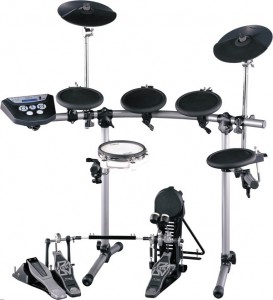
Pretty damn hard to look cool while playing this.
Around the same time I was getting a bit frustrated with the dorky electric set, I found out you could take an acoustic set, gut it, put some magical shit inside, and have it work like a silent electric set. Hell yeah! Now that’s what I’m talking about. I could still practice without bothering people, and look and feel cooler doing it. It was officially on. I bought a nice looking black Tama superstar kit for my conversion. In hindsight, I probably should have gone for an even cheaper drum set, but oh well.
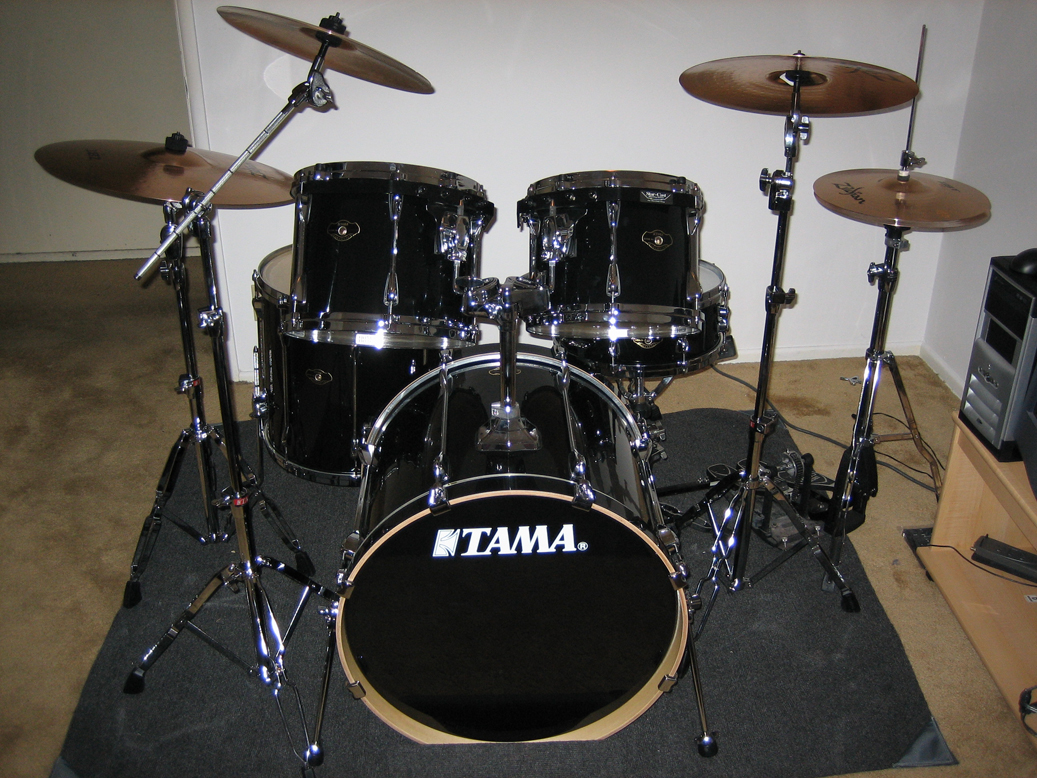
My Tama drum set before I converted it.
So, step one was understanding what the hell turned me whacking some random pad into sounds that came out of a little magic box. Turns out it is all about the “piezo.” Piezos, as far as I can tell, are magical relics left by elves of the middle ages. If you whack them, they turn the whack into electricity. If you shock them, they move. It’s crazy, really. I implore you to read all about them. Unfortunately, the piezos are a bit fragile. Smacking them with a drumstick is pretty much guaranteed to break them, so you need something to dampen the blow. In electric drums, this is often done with a foam cone. The tip of the cone touches the drum head, and the cone sits on top of the piezo.
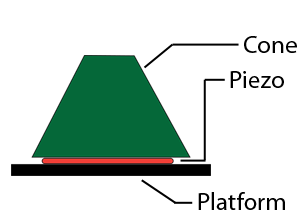
A diagram of the cone assembly.
Piezos solved the problem of how to turn my drum stick hits into something that can be interpreted by my magical drum computer. However, I still had the problem of getting them in the drum and making the drum silent. Let’s start with mounting the cone assembly in the drum. Most drums have a lot of little screws inside them that hold the lugs on.
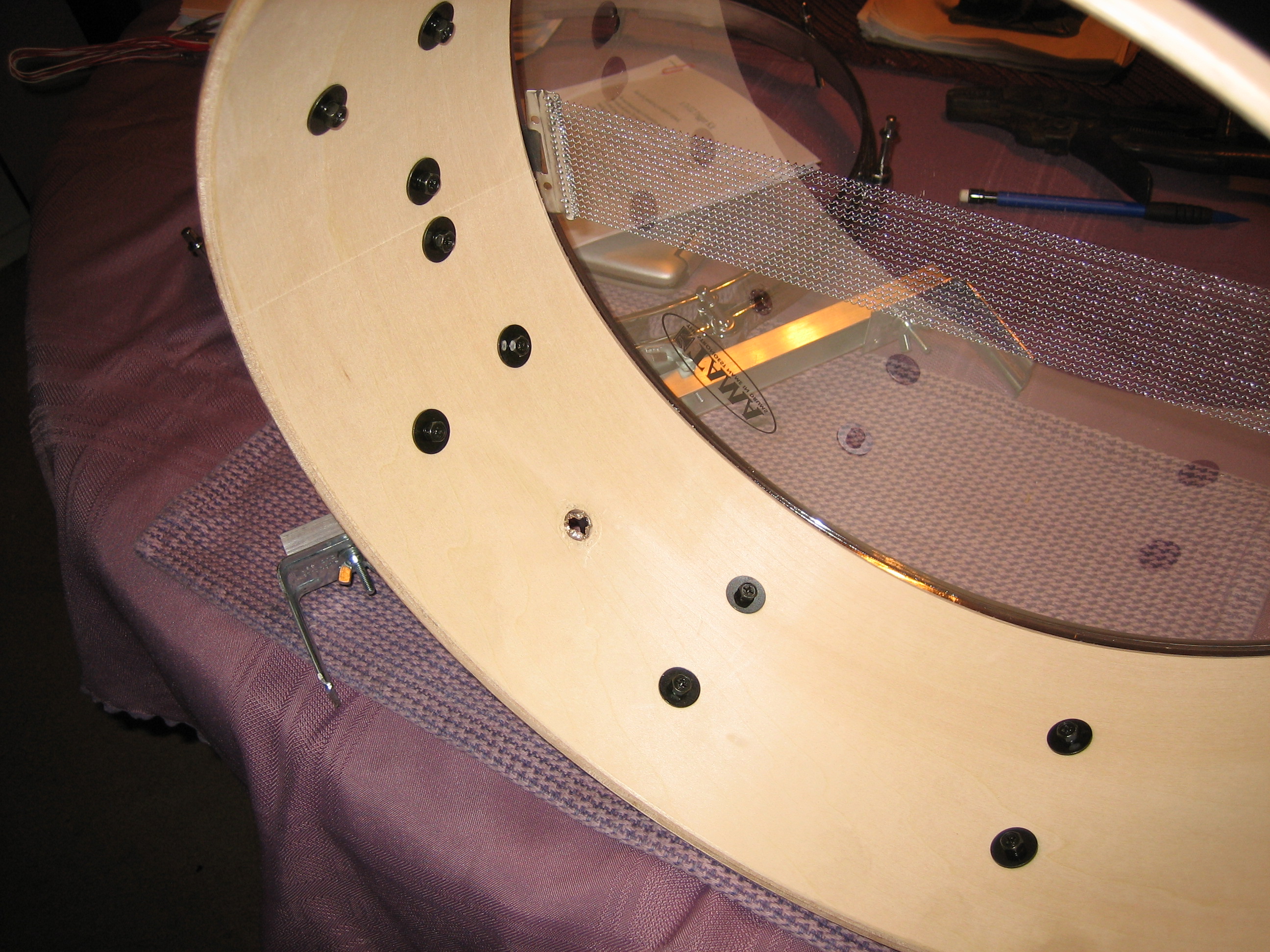
The inside of my snare with lots of little screws useful for attaching things to.
A little creative (or not-so-creative) metal work and I had things all attached and set up. I have a slotted bracket on each side of the drum that is held to the drum shell by the lug screws. I then have a bar that runs the length of the drum attached to the brackets. Sitting on the bar is my cone assembly. On most drums, I also wired four more piezos to the shell so that I can detect when I hit the rim instead of the drum head (or both at the same time).
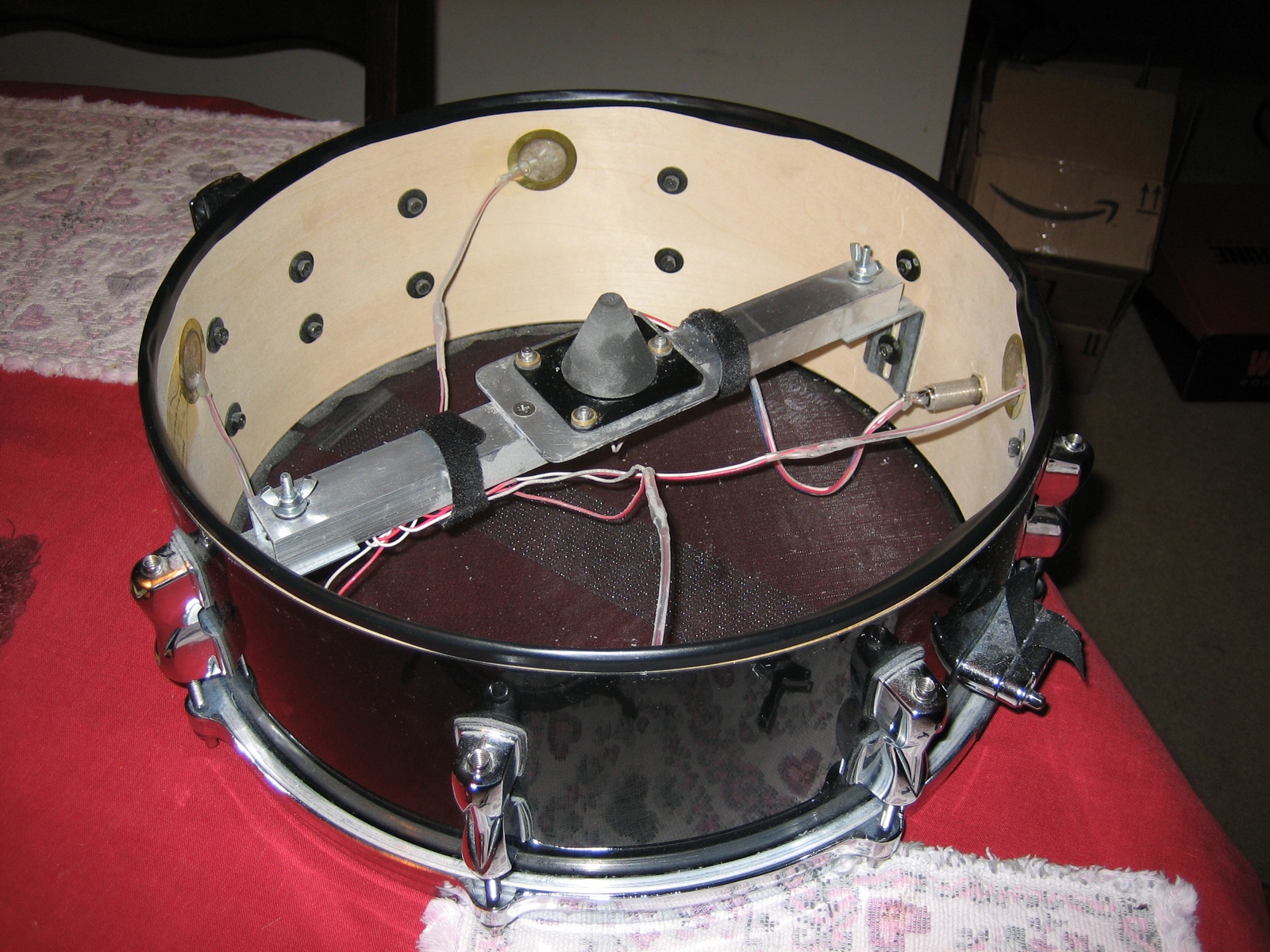
Here is the snare with the electric components all mounted inside of it. Note the snare wire serves absolutely no purpose here.
Next, making the drum silent. Turns out, this is fairly easy. Drums make noise because striking the drum head causes a big burst of air to travel down. It’s the same way a speaker cone moves and makes sound. Poke enough holes in a drum heads, and the air will just escape out the top or bottom and you won’t get much sound at all. It’s like knocking on the screen part of a screen door versus knocking on a nice hollow wood door. In fact, that’s almost exactly how we handle it with drum heads. One can buy “mesh” drum heads. They’re basically screen door material that is stretched really tight. You hit them, and it moves the cone and triggers the piezo. But, the air escapes easily so it produces very little sound. There are a handful of brands of mesh drum heads one can purchase. The best ones are made by Roland, but they really dislike people doing these sorts of projects and have stopped selling most of the mesh head sizes needed for a kit like this.
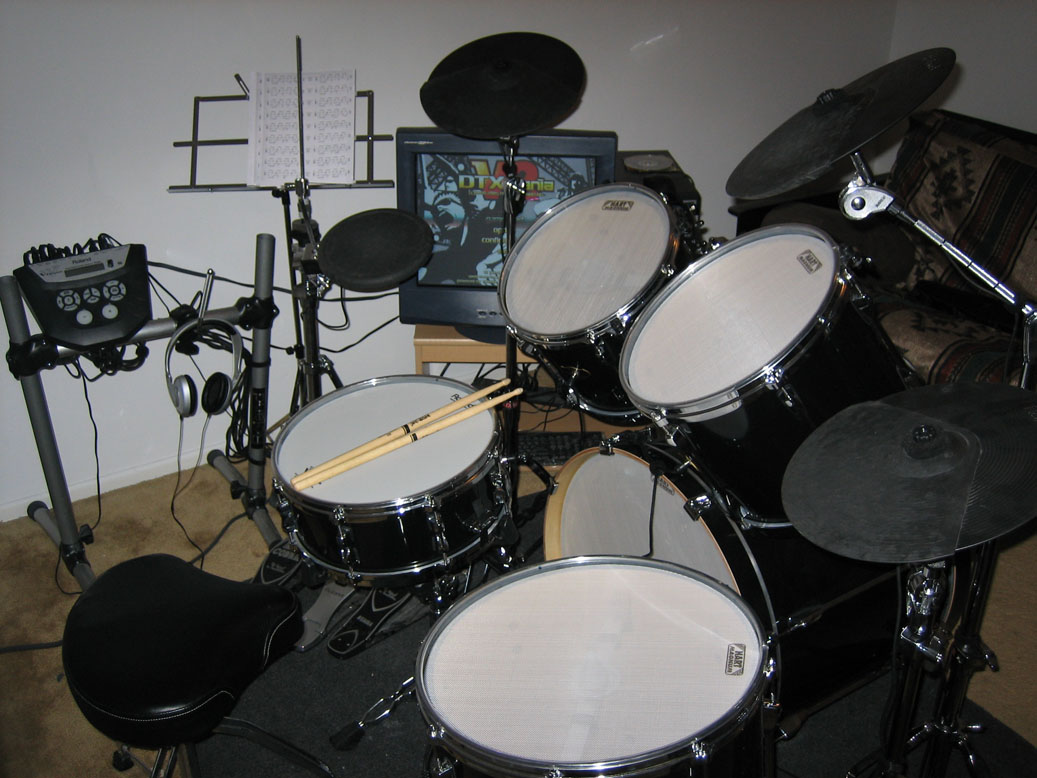
Acoustic kit after converting the drums to electric.
I converted all of my shells to electric drums and thus completed the first phase of my acoustic to electric conversion. I could have stopped there but I wasn’t satisfied yet. It worked pretty well, but it could be better. The first thing I was really unhappy with was the cymbals. Especially that lame TD-6 hi-hat setup. I found a company called Smartrigger that made these incredibly realistic looking electric cymbals. I thought I would give them a try.
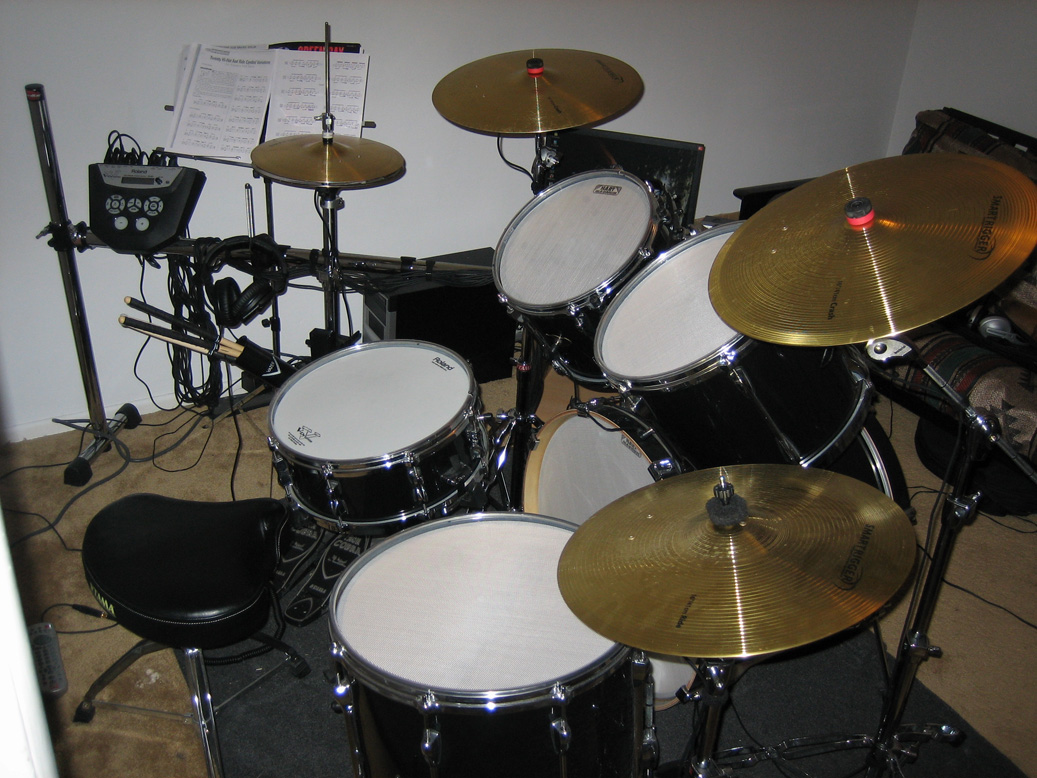
The acoustic to electric drum set with the Smartrigger cymbals.
As you can see, the Smartrigger cymbals looked nice. There was a problem though. They kept breaking almost immediately. I sent one back for repair and the company even made me pay for shipping. A week after I got it back, it broke again, and soon after that, another broke. I said screw it and cut my losses. I was done with that company. I decided to go with Roland for my cymbal needs.
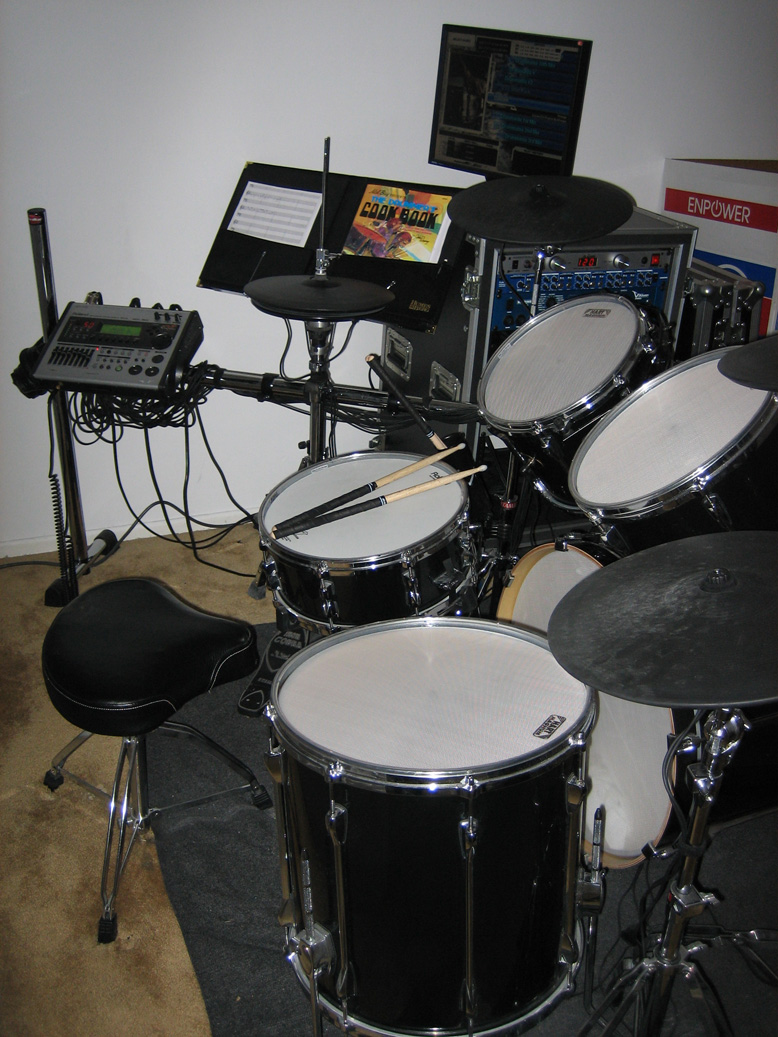
The almost final layout of my acoustic to electric set.
The Roland cymbals were a little more lame looking, but they triggered better and wouldn’t break on me. At the same time, I replaced my TD-6 module with a TD-20 and built this awesome audio rack. As far as an authentic feel goes, nothing in the electronic cymbal realm beats the VH-12 hi-hats. They trigger beautifully and use a standard hi-hat stand.
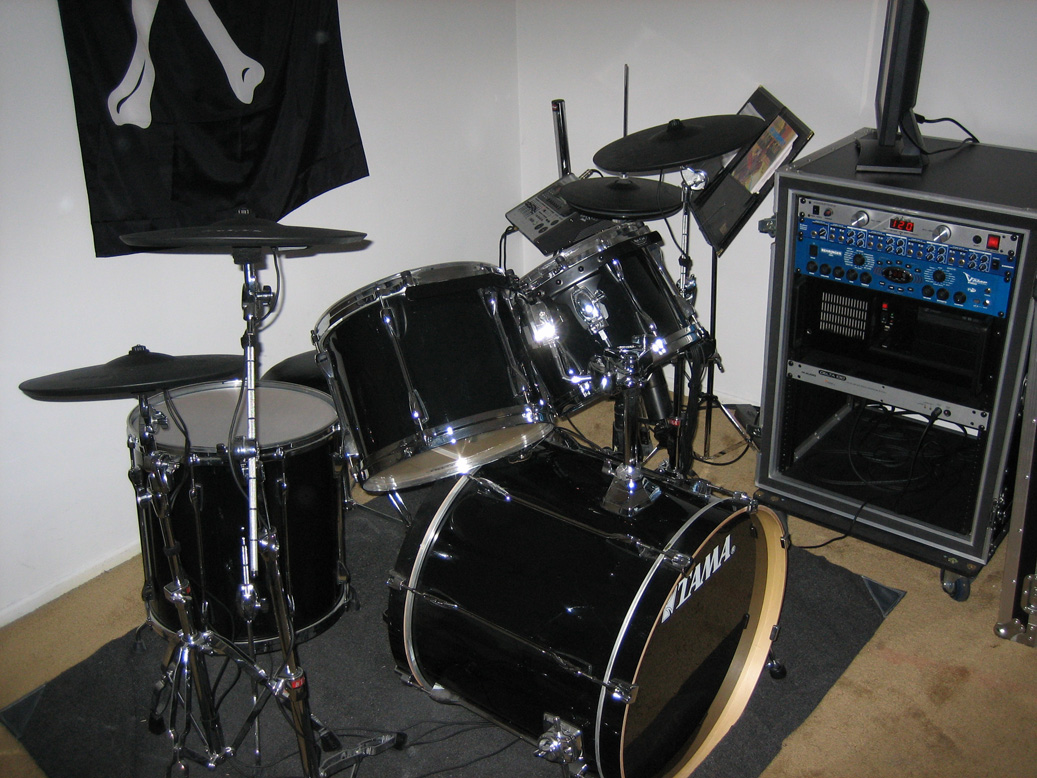
From the front, it still almost looks like an acoustic set!
Kit mostly complete (my current setup has one extra cymbal), I started learning of all the cool things an electric kit allows me to do. Beyond practicing without pissing off everyone around me, I’m also able to play DTXMania. If you’ve ever played the drums in the video game Rock Band, then you kind of know what DTXMania is. However, it much better because it uses my much more realistic feeling set and allows for more triggers than Rock Band does.

A DTXMania scoring screen after playing a song.
So that’s the story on my electric drum set that looks like an acoustic one. If you want to learn a whole lot more about these sorts of acoustic to electric conversions, check out the VDrums.com forums. Aside from tutorials on how to build one of these things, they also have product reviews on mesh heads and just about any other kind of information you could want relating to electric drum sets.
This is awesome information! I’m currently playing with an industrial/synth pop group and they want me to use my TD-12. It’s a great kit, but its seriously lacking in feel and the kick drum pad is the most heinous piece of crap ever concieved. I did try using ddrum triggers with my Mapex Orion, but I had a stupid ammount of problems with miss triggering. Obviously I can’t convert that to electronic because it was stupid money, but I’m in the stages of picking up a second hand kit to convert. This info has been really helpful thanks.
Danny
You’re most welcome, thanks for the comments. When it comes to triggering the bass drum, it is the one piece I don’t have a full cross bar internally for. The trigger on mine sits about 6 inches from the edge in the upper left, rather than the center. Most people don’t seek quite as much control over dynamics on the kick as they do on all the other drums, and that is true of mine. However, it still never misses a hit, so it is probably better than the ddrum. The other important thing to remember when modifying the kick is to have one of those kevlar patches. Otherwise, you’ll dig right through the mesh head in no time.
And good call on not converting the Orion 🙂 There is no good reason not to go with a very inexpensive kit for these conversions.
awesome 🙂 can i ask what you used for the foam cones? I can pick up piezo’s for next to nothing, and i’ve got access to a workshop where i can create the cross bar’s easily enough, and the wireing up to a female jack shouldn’t bee too much hastle (i hope)
Because of the musical project i’m thinking about converting a ddrum Diablo kit. the sizes of drums are ideal, and the black with red hardware would really suit the onstage appearance. And the kit’s reasonable priced too.
any more tips you can think of would be really helpful thanks 🙂
Firm roland cones for the snare/toms. While you’re making crossbars, do yourself a favor and make a really long bar that stretches across the diameter of all of your shells (or use a yardstick). This will make it easier to position the height of your cones. You want them about an 1/8″ above the edge of the shell. This should translate to being about the perfect location for it when you get the mesh heads on. On my super-long crossbar, I grooved out a little 1/8″ deep slot in the center. If I can slide my crossbar across it and it doesn’t snag, it means I’ve positioned the cone low enough.
Just about any cone will do for the kick. I have a softer foam cone in my bass drum. This was NOT because I was well-informed and chose soft because I possessed some sort of some supreme encyclopedic knowledge. Quite the opposite, in fact. My conversion started out with a soft foam on ALL of the drums. It didn’t take long to find out that the firmer Roland cones are much better for anything I’m hitting with a stick. The kick drum, however, is more versatile. You’re dealing with a much larger source of energy (from the beater) so you have more range to work with. Even a soft kick beater hit sends a pretty powerful wave through the cone. This is great because it is a nice clear signal for your TD-12 to work with. “Tuning” the kick should ultimately be FAR more trivial than tuning your snare. Toms will fall somewhere in the middle.
And yeah, the wiring should be fairly trivial. If you’re going to have rim piezo’s on the shell, I found that double sided tape didn’t work well at keeping them in place. Instead, I used wood glue to permanently fix them on the side. You just need to be committed to them being there, because they won’t come off very easily once that wood glue dries =)
And as a look and feel goes, I think the Diablo kits would look totally badass. Especially for this type of project and for an industrial band.
thats fantastic information thanks Jacob 🙂 just one last question.. where did you buy the roland firm cones from?
With the kickdrum.. the funny thing is, on the TD-12 kick pad, it’s also a soft one large enough to accomodate twin beaters, so that worked out really well even if by accident!
You’ve been a great help, and I’ll keep you posted with progress. Hopefully I’ll be up and running by the summer. I know the band have a US tour comming up, so If i can get it going for that then i’ll be really happy
Well, after I had trouble with the soft cones, I went on ebay and hunted out used/cheap PD-80s. Then, I gutted them. I took out the entire cone/piezo assembly and then mounted it on my crossbars. That’s what you see mounted in the picture above. The problem with this method is how long it can take for good PD-80 deals to come around on ebay. I wasn’t in any hurry to get the thing built at the time. There is no reason you NEED to gut a PD-80, I was just lazy and didn’t want to go through the hassle of delicately attaching the cones to the piezos again (after having been burned with soft cones the first go around). However, I have seen just the cones for sale on ebay quite often. You could probably also call Roland and order a few cones.
Let me know if you’re band is gonna stop by the Los Angeles area while on tour 😉
Thank you for a no nonsense simply written piece that a DIY electric kit newbie can grasp. As for my standard TD8: “It’s a great kit, but its seriously lacking in feel and the kick drum pad is the most heinous piece of crap ever concieved.” applies equally. I’ve actually used cut down cheap acoustic drums with mesh heads to make pads and I am having allsorts of triggering problems with Ddrum red shots… I was eyeing up the old PD 80 pads as trigger donors earlier and I think your feature has confirmed it a good way to go.
Cheers,
Chris.
Hi,
Great job must say. I have a question for you,
I have problems with my td12 snare rim shots, it thoesn’t trigger the same all arround the shell. Would it help mounting another piezo on my side of shell and would there be any problem with signals or anything else if i do so?
Thank you,M
Another piezo on the side of the shell shouldn’t hurt. My snare has 4 on the shell for rim shots. You may end up with a scenario where you trigger multiple times by adding extra piezos, in which case you would just adjust your trigger settings, but even this hasn’t really been an issue for me.
So if i get it right, they would send 2 different signals at different times?
What if i just move piezo to my side of snare in the middle?
Can u also please state your trigger settings if u’re using roland td 12 or td2o module in case i add more piezos and which piezos have you used?
The two rim piezos will be wired together. To the module, this will appear like one piezeo who ends up getting two voltage spikes. One spike would be a bit smaller than the other. The distance between the two spikes would be the amount of time it takes for the shockwave to travel through drum itself. The Roland modules already know how to deal with these multiple spikes to some degree. If you’ve ever seen a drumhead strike on a high-speed camera, you’ll see that the drumhead ripples and there is an echo-y effect in the wave. As such, the electronics know not to retrigger a second, third, fourth time, etc. Also, if you take a look at the manual, you’ll see their waveforms show this pattern of diminishing strikes.
As for my trigger settings, they would not necessarily work for you (plus I’m not near my TD-20). It’s just a bit of trial and error. When you start modifying a kit, the thresholds and sensitivity can vary from drumset to drumset.
Hey Jacob, this is awesomely helpful. I had exactly the same idea (acoustic drums with mesh heads & piezos, electronic cymbals & hi-hats), and I’ve been looking at Cannon Adder kits on eBay since they seem to be well-reviewed and, with luck, you can pick one up for about £50.
I was wondering how much of a hammering electronical cymbals can take? I’m not a subtle player (LOUD = GOOD; LOUDER = GOODER), and I’m not keen on laying out hundreds of millions of pounds for rubber discs that will bust the first time I try playing along to Them Crooked Vultures.
Also, do you get a significantly different feel/response from mesh heads?
I’m a very hard hitter myself, so I can relate. The electronic cymbals from Roland can take quite a beating. The ones I had from Smart Trigger could not. I think you’ll be OK. In general, if you hit light enough that acoustic brass cymbals aren’t constantly cracking, you’ll be fine with the roland rubber ones. They’re not indestructible – but they last me a very very long time.
Yes, the Mesh Heads can have a lot of range in terms of feel. The absolute best was when Roland sold 14″ mesh heads for their cymbals. They stopped doing it at some point, which was a real shame. I’ve found the Hart Dynamic Magnums to be the second best. Being a hard hitter, you’ll burn through these at a decent pace where as the Roland heads will last you forever. In general – the more ply – the more solid and nice they’ll feel. Since you’re in Europe, you may try looking for someone selling triple-ply mesh heads. Here in the States, we can’t get them because of a patent Roland has on that technology. Your luck may differ in Europe – I know Germany is known for selling them.
I can totally buy stuff from Germany. I’m a quarter German! That has to count for something.
The problem I’ve found in looking for mesh heads is trying to find classic sizes; so 13″, 14″, 16″ and 20″. I found ONE brand of double-ply in those sizes called Z-ED that are surprisingly inexpensive, but I tend to go through coated Emperor heads once every few months, and I only practice for a couple of hours a week :/
Thanks for the info though – I’ll be on the hunt for triple-ply heads, and I’ve bookmarked this page for when I finally get around to piecing together my piezos.
Hey man! im trying to do the same with my kit, but the biggest problem i have is my bass drum, i keep punching holes in the mesh and destroying my triggers. I play metal/deathcore so that “click” kick and speed is my priority. Any suggestions on what i should do? should i just put a regular head on it with an acoustic trigger??? And plus could I use triggers for sound aAND light? im trying to make a DIY version of the SJC light up drum kit. Also, their is a company that sells triggers with harnesses that go right behind the head (advantages/disadvantages?) instead of putting the crossbar piece in the drum. I am desperate to see if i can get my dream kit together, i am an edm artist at heart, so i want to put all kinds of crazy samples across my kit for a unique sound that is similiar to dubstep/trap music. ANY help would be appreciated…
Jake,
I had the same issue with destroying the mesh head on the kick. I found that putting the Remo Falam Slam Pads (they make one for double bass) on my mesh head really helped increase the durability.
In terms of the other forms of triggers, I can’t really comment as I haven’t played with them much.
Hope that helps!
thanks for the info dude!